
In my last blog post, I spoke about the first key to grammar success, which says to integrate grammar instruction into both your reading and writing lessons. If you haven’t read that post, now might be a good time to read it before continuing on. Click here to read about Key #1.
Still with me? Cool. Today, we’re going to learn about the second key to successful grammar instruction: Mimic & Manipulation – Don’t Memorize.
As we learned in my last post, grammar isn’t about memorizing rules and terms. And it’s not about the right versus wrong way to write sentences. Instead, grammar is about choices writers make and some of those choices might be more effective than others in producing the desired effect upon the reader.
However, in order for our young writers to effectively access those choices, we need to teach them about the grammatical structures they can choose from. That means we need to first call attention to well-written juicy sentences from the texts we’re reading, so that kids can analyze, then mimic them. These sentences are called Mentor Sentences.
Table of Contents
The 411 on Mentor Sentences
Ultimately, we want our students – no matter what grade level – to become effective communicators and mentor sentences are one way to accomplish that goal. They are an effective and easy way to help kids learn and practice grammar and conventions and develop their own style or writer’s voice.
Please note that these mentor sentences should be WELL-WRITTEN, not filled with errors for the students to correct. Correcting sentences reduces grammar down to a hunt for errors and is NOT considered a best practice in grammar instruction. And while TPT is filled with mentor sentence resources (3,600+) that you can purchase, your mentor sentences really should be pulled directly from a text you have or will be reading.
So what might a mentor sentence lesson look like? Well, if your students keep a journal for their daily writing, mentor sentences can be a weekly component where students record a mentor sentence you have selected and highlight key features of the sentence. From there, kids craft their own sentences to match the same grammatical structure, sharing their new creations with peers and the whole class.
But don’t stop there. Challenge your students to add a similar sentence in an authentic writing piece that they’ll be working on that week. This might be a simple journal entry, text summary, or a longer writing piece. It’s a practice that author Brock Haussamen recommends in his book, Grammar Alive! A Guide for Teachers. Similarly, middle school teacher and author Gretchen Bernabei discusses in her book, Grammar Keepers: Lessons that Tackle Students’ Most Persistent Problems Once and for All, her practice of awarding students “star points” for students using a recently taught grammatical skill multiple times in their own writing.
In the book, What Works in Grammar Instruction, author Deborah Dean writes, “Students learn to use imitation and sentence combining in playful ways to build options for their writing. The practice with these activities should encourage risk-taking, which means they can’t be graded. Instead, these activities should help students learn options they have for their own writing . . .”
Regardless of how you structure your mentor sentence routines, ultimately we want the kids to build up fluency with their writing, right? That means kids need ample time to experiment with their grammar in writing in a low-stakes way. Which brings us to our second grammar best practice for today . . .
Sentence Combining & Manipulation
Hands down, sentence manipulation is my absolute favorite way to get kids to master grammar skills. Why? Because writing and grammar instruction is a time to play with words, to build and rebuild sentence structures, and to experiment. For me, this process leans heavily on peer-to-peer communication, collaboration, and critical thinking, resulting in high student engagement, but little to no stress.
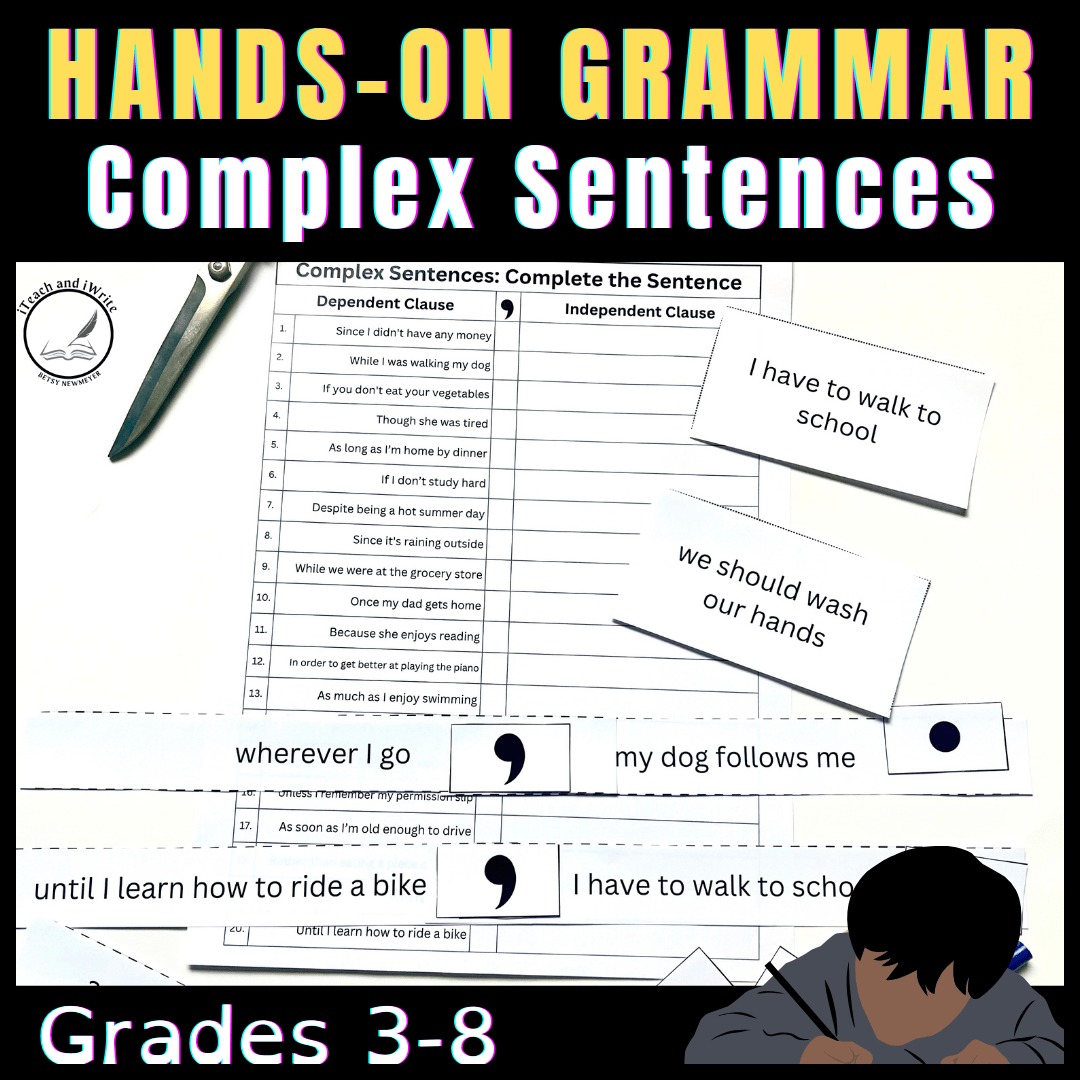
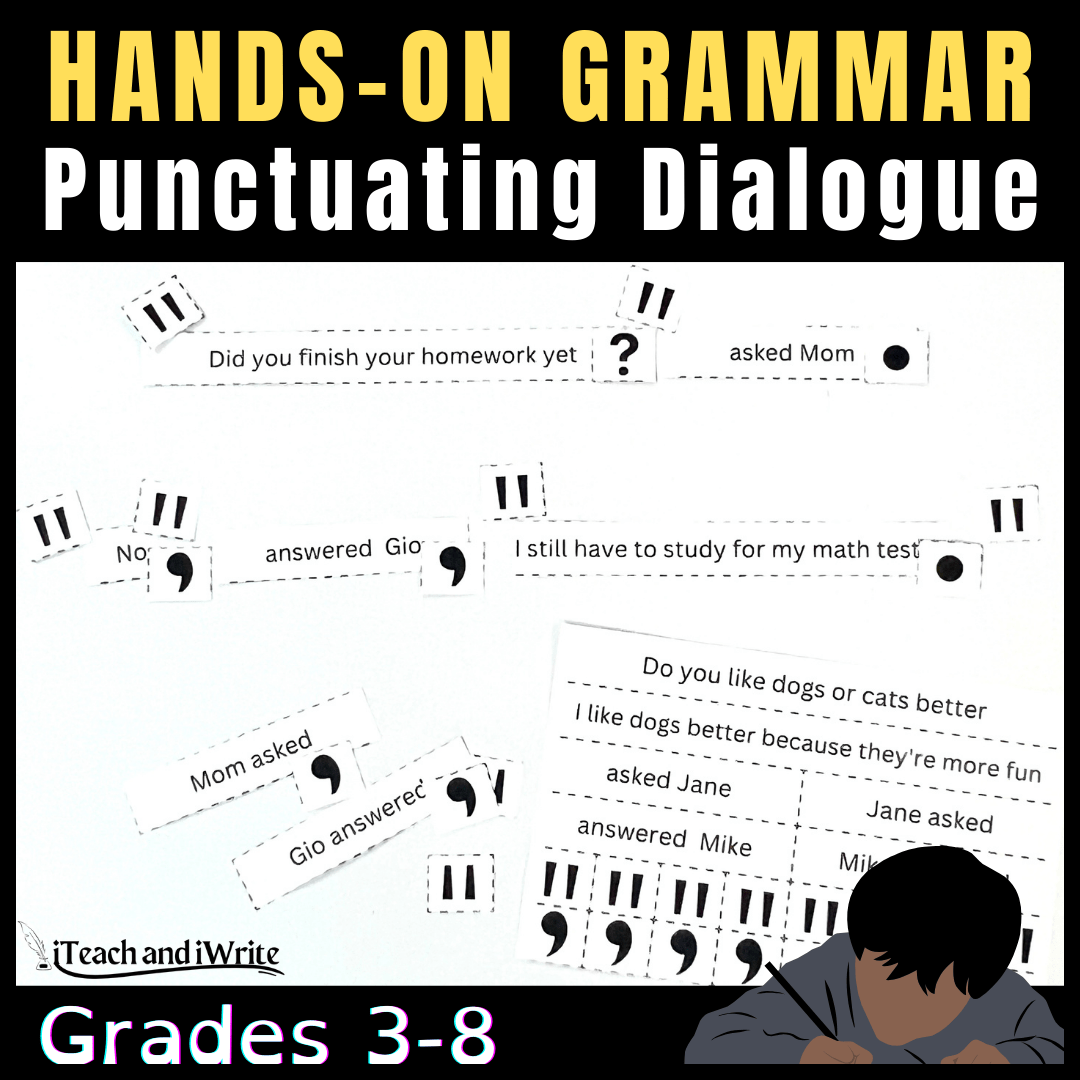
In my class that means we’re physically manipulating sentence chunks to build, expand, and condense sentences. Usually we’re sitting on the floor, (a practice I loved and kept from teaching primary grades), our sentence pieces and punctuation marks printed out on cardstock and cut apart. We work with our peers to build and punctuate our sentences.
Now this is typically a grammatical structure I’ve selected from a text we’ve recently read (or will be) and it’s also something I want my kids to use in their next writing project. We might have analyzed this structure by way of a mentor sentence and now I want my kids to practice this concept a bit more.
When we share out the sentences we’ve created, I have my students read the punctuation and capitalization aloud, which helps reinforce punctuation rules. It sounds like this:
CAPITAL I love my baby sister COMMA Faith COMMA because she is cute and fun to play with PERIOD.
To make things extra fun, sometimes I’ll place the pre-made sentence chunks in plastic eggs or dole sentence pieces out to students so that they have to find their partner who has the corresponding sentence chunk.
Since most of my 5th grade grammar standards deal with comma rules, I have already created a series of hands-on sentence manipulation activities to practice each of the comma rules. You can easily create these activities on your own, but if you’re in a hurry and want ready-made grammar resources, I’ll link the buy links below.
Sentence Combining with DRAFT
Another way you can address and practice sentence combining requires a small amount of prep ahead of time but doesn’t require any copying of worksheets or cutting out sentence parts. Here’s how it works: Select a rich or juicy sentence from either a familiar text or a text you’ll soon be reading. Decompose the sentence, breaking it into several small sentences that students will then combine. I first show the decomposed sentence on a Google Slide and display it for my students on our interactive TV so that we can use the annotation feature to do our sentence constructing.
Let’s take this sentence from page 35 of George Takei’s picture book, My Lost Freedom”. The original sentence looks like this:
When I asked Daddy about the radicals, he said, “In a democracy, the people have the right to assemble and protest.”
I can decompose that sentence like this:
I asked Daddy about the radicals.
He said, “In a democracy people have rights.”
He said, “People have the right to assemble.
He said “People have the right to protest.”
I’m sure there are other or better ways to decompose this sentence, but this is the way I’m choosing to do it today. So these four shorter sentences are what I present to my class first. We use the acronym DRAFT to help us analyze, discuss, and manipulate these sentences, combining the bits of info in a variety of ways.
DRAFT stands for DELETE repeated or unnecessary words, REARRANGE words or clauses, ADD connectors (conjunctions or punctuation), FORM new verb endings, and TALK it out. As always, I remind my students that we want to create a few different versions of the sentence we’re building so that we can select the one we like the best. It isn’t about finding the “right” answer. And sometimes, we even like our version better than the author’s sentence. My students loved doing these grammar activities and would easily stay engaged for an hour or more.
For a deeper look at DRAFT, be sure to check out my more in depth blog post and pick up the book Revision Decisions by Jeff Anderson and Deborah Dean, or check out this blog post from the Two Writing Teachers website: https://twowritingteachers.org/2014/11/10/rdblogtour/
Your Mission:
Which best practice would you like to try first: mimicking mentor sentences, or sentence combining? Select a mentor sentence from a text you have read or will be reading soon with your students and add the activity into your lesson plans and prep any materials you might need. Think through and establish the routines you want kids to follow, so that everyone is actively engaged and feel safe to take academic risks.
Want More?
So that’s it for this post. Stay tuned for our next post on the last key to successful grammar instruction: Relevance, Not Routine. Until then, why not join my newsletter, where I send out teaching tips, news about new TPT resources, and periodic freebies. You can unsubscribe at any time (although I hope you won’t!).
Click here to join mailing list.
Related TPT Resources
To check out all of my hands-on and digital grammar activities, click here.